By Martin Lehner (@anotherlehner)
To implement field of view I had to make one major change to the way my code was organized: I needed to start using a C struct from libtcod called TCOD_map_t to store my map for field of view. Instead of changing a whole bunch of things and trying to get rid of my own map struct I decided to simply store a TCOD_map_t in my map struct and manage it internal to the map. This way the callers using the map don’t have to interact directly with the tcod map structure and instead get the nice facade of Zig functions instead.
pub const TcodMap = c.TCOD_map_t;

pub const Map = struct {
    width: i32,
    height: i32,
    cells: []Tile,
    tcMap: tcod.TcodMap = undefined,
    allocator: Allocator,

    ...
}
In places where I’m managing the cells array of Tiles I also set the same values on the transparent and walkable properties of the TcodMap. Example:
pub fn set(self: *Map, x: i32, y: i32, tileToSet: Tile) void {
    if (!self.inBounds(x,y)) std.debug.panic("outside of map: {d},{d}\n", .{x,y});
    self.cells[self.idx(x,y)] = tileToSet;
    tcod.mapSetProperties(self.tcMap, x, y, tileToSet.transparent, tileToSet.walkable);
}
At the moment this is a bit inefficient since I’m mirroring the same walkable and transparent properties on my own Tile structures. I’m looking to get rid of that in the future and somehow eliminate that redundancy. For now it works.
Now that I have a TCOD_map_t structure I create it using a function in libtcod and fill it up with the same values that my tiles already have. Computing the field of view is now very straightforward:
pub fn computeFov(map: TcodMap, povX: i32, povY: i32) void {
    _ = c.TCOD_map_compute_fov(map, povX, povY, 8, true, c.FOV_BASIC);
}
This simple function takes the x and y position for the center of the field of view and a TcodMap (which is an alias for TCOD_map_t). Here I call the C function provided by libtccod and give it a few extra params for radius size, type of field of view calculation, etc.
I then added this to my engine function:
pub fn handleEvents(self: *Engine) void {
    ...
    tcod.computeFov(self.map.tcMap, self.player.x, self.player.y);
}
All that remains is to update the renderer…
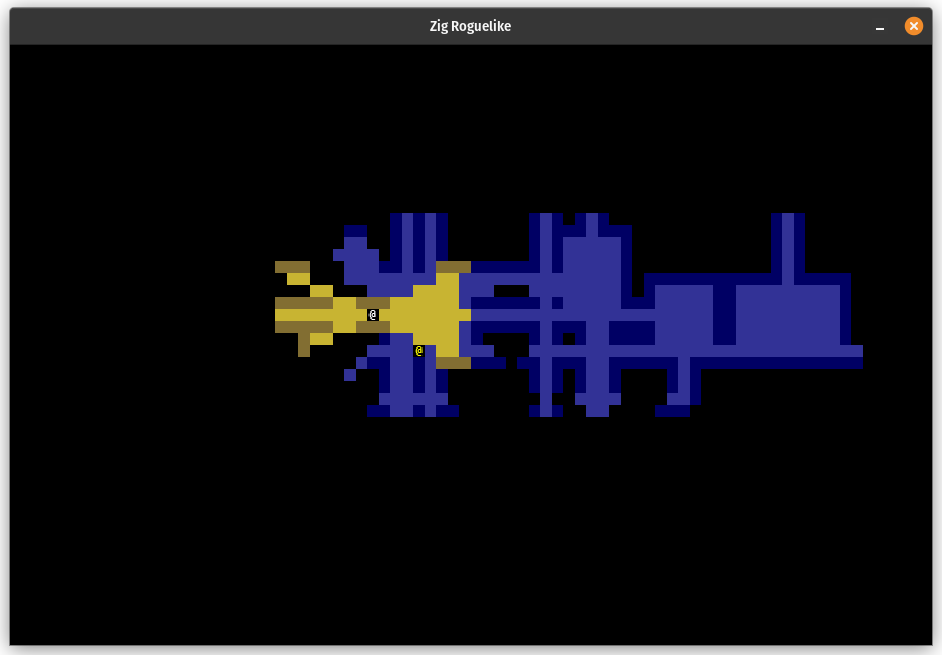
Before this part 4 code I was rendering the tiles to the console by simply going through the long single-dimensional array of tiles and transferring all the tile and graphic data to the libtcod console. Very simple. Now I have the extra TCOD_map_t and it’s own libtcod functions to work with it so I modified it to work with both:
pub fn renderMap(console: TcodConsole, map: *models.Map) void {
    var x: i32 = 0;
    var y: i32 = 0;
    for (map.cells, 0..) |t, index| {
        if (mapIsInFov(map.tcMap, x, y)) {
            map.cells[index].visible = true;
            map.cells[index].explored = true;
        } else {
            map.cells[index].visible = false;
        }

        if (t.visible) {
            console.tiles[index].ch = t.light.ch;
            console.tiles[index].fg = t.light.fg;
            console.tiles[index].bg = t.light.bg;
        } else if (t.explored) {
            console.tiles[index].ch = t.dark.ch;
            console.tiles[index].fg = t.dark.fg;
            console.tiles[index].bg = t.dark.bg;
        } else {
            console.tiles[index].ch = models.SHROUD.ch;
            console.tiles[index].fg = models.SHROUD.fg;
            console.tiles[index].bg = models.SHROUD.bg;
        }

        x += 1;
        if (@mod(x,map.width) == 0) {
            y += 1;
            x = 0;
        }
    }
}
Some comments:
TCOD_map_is_in_fov, which requires coordinatesvisible and explored flags on the particular tileWith part 4 done a new screenshot is born: screenshot.