By Martin Lehner (@anotherlehner)
Encountered a lot of challenges doing this part…
In Zig, to create random integers we need to use the std.rand namespace struct DefaultPrng. This is the default pseudorandom number generator. It’s a little odd at first because you make a DefaultPrng struct and then access the random functions through an embedded interface. Here’s what that looks like:
// import
const RndGen = std.Random.DefaultPrng;

// initialize the randome generator
var rnd = RndGen.init(0);

// seed the random generator using the current time
rnd.seed(@intCast(now.timestamp.sec));

// get a random i32 integer between room min and max size (at most means this is inclusive of room max size)
const roomWidth = rnd.random().intRangeAtMost(i32, room_min_size, room_max_size);
The part where I do rnd.random().intRangeAtMost... is the weird part for me. Usually the interface is something you pass around and call to get into the implementation underneath. This seems like it’s reversed? I’d like to work on understanding this more and then try to setup something similar in my own structs.
I think this part is the first where I used an ArrayList. I used this structure in this part for making lists (slices) of coordinates to pass around and iterate over.
Here’s one example:
pub fn inner(self: RectangularRoom, allocator: Allocator) ![]Coord {
    var innerList: ArrayList(Coord) = .empty;
    defer innerList.deinit(allocator);
    var xi: i32 = self.x1 + 1;
    while (xi < self.x2) : (xi += 1) {
        var yi: i32 = self.y1 + 1;
        while (yi < self.y2) : (yi += 1) {
            try innerList.append(allocator, .{ .x = xi, .y = yi });
        }
    }
    return innerList.toOwnedSlice(allocator);
}
This could use some refactoring but it’s an example… For any rectangular room we want to be able to get the inner parts as a list of coordinates that can then be “carved out” of the map by setting those cells to be floor instead of wall.
It’s really important to remember to defer the deinit call here after creating the array list so that it gets de-initialized when the function exits.
The final call to toOwnedSlice() creates a slice pointing to all the elements we created that can be iterated over by the caller of this function. The caller also needs to remember to free the owned slice so we avoid a memory leak! Here’s the bit that uses this code:
const roomInner = try room.inner(allocator);
defer allocator.free(roomInner);
for (roomInner) |coord| {
    map.set(coord.x, coord.y, models.FLOOR);
}
The last thing I want to mention here in this summary of part 3 is line creation. The libtcod library has some functionality to create lines of x/y coordinates using the Bresenham algorithm. The C API has a couple different sets of functions to do this and I think I used deprecated functions but either way…
pub fn line(start: Coord, end: Coord, innerList: *ArrayList(Coord), allocator: Allocator) !void {
    if (start.eql(end)) {
        // Only seems to happen because a corner wasn't needed
        std.log.info("line: zero length line sequence {} == {}", .{start,end});
        return;
    }
    var x: i32 = undefined;
    var y: i32 = undefined;
    tcod.lineInit(start.x, start.y, end.x, end.y);
    _ = tcod.lineStep(&x, &y);
    try innerList.append(allocator, .{ .x = x, .y = y });
    while (!tcod.lineStep(&x, &y)) {
        try innerList.append(allocator, .{ .x = x, .y = y });
    }
}
x and y are given to the lineStep function, which internally calls the libtcod line step function, which itself puts the next coordinate pair of x/y directly into the memory addresseslineStep returns false and the line endsI will try to improve this for the future and try putting the x/y memory address variable inside my tcod.lineStep function instead of exposing that machinery here. Another good improvement would be to stop swallowing the first lineStep result and actually check for it. This code assumes we always will have at least 1 cell to cover but that seems to have been a misplaced assumption.
Update: I actually found this interesting:
var x: i32 = undefined;
var y: i32 = undefined;
tcod.lineInit(1, 1, 1, 1); // start: 1,1 and end: 1,1 (0 length line)
var firstStep = tcod.lineStep(&x, &y);
I would think firstStep should return false here because the line is 0 cells long and shouldn’t set anything in x and y. Indeed nothing it set in x or y and they just have garbage in them. Unfortunately lineStep here returned true and my loop, which followed these lines, just kept going – and blew up. Really seems like that should return false, but maybe that’s one reason why it’s deprecated? I should try the other functions available for drawing lines.
You can see all the updated code in the src folder for this part. I think discussing things I found interesting, new, or problematic and putting aside trying to develop a full blown tutorial here is helping with time. Perhaps when I’m done with all thirteen parts (cross fingers) I’ll come back and rewrite all these readmes into a full Zig roguelike tutorial… if someone doesn’t beat me to it first.
:)
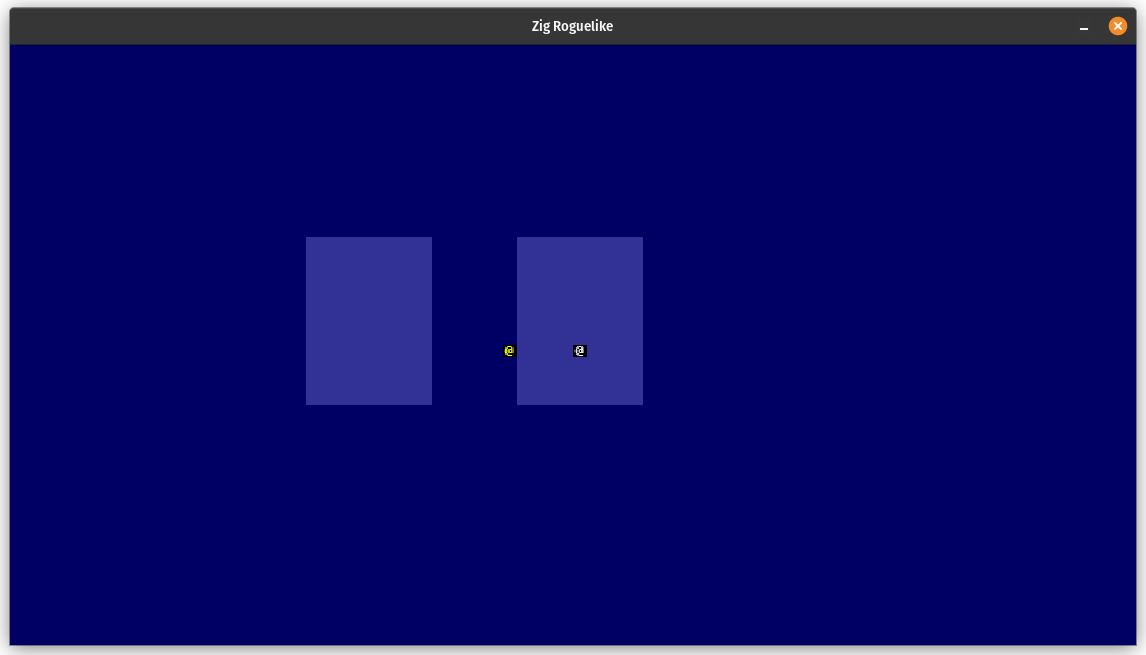
picture of basic rooms with tunnel in between: screenshot
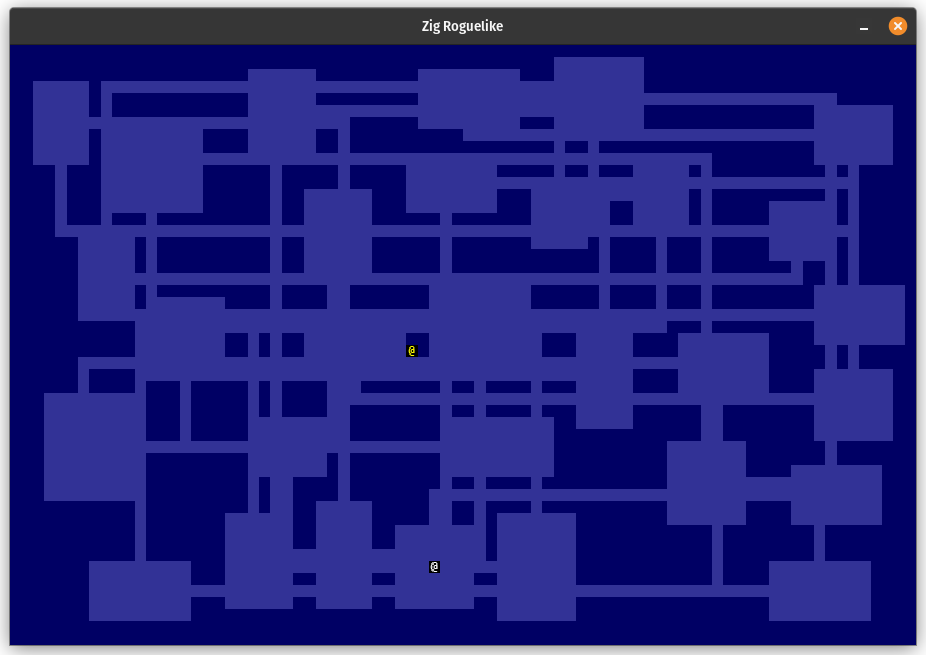
closing picture of the dungeon: screenshot